

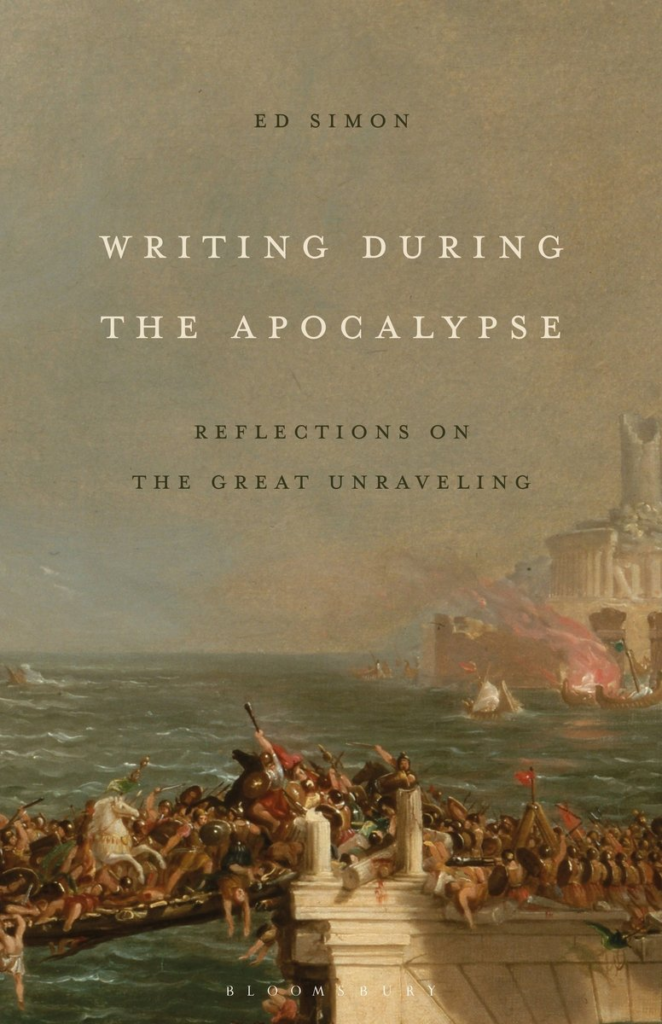
In the Bible’s Book of Revelation, the end times are visited upon humanity by the four horsemen of the apocalypse. The white horse symbolizes pestilence, or disease; the red horse, war and bloodshed, particularly civil war; the black horse, famine, with the price of food rising while wages stagnate; and the pale horse, death.
This imagery is not just limited to the Bible, but was seen to have happened to the Roman Empire, as well. Those who have interpreted the four horsemen as applying to the present day have given the horses different representations, for example Evangelical interpretations by American protestants: white—Catholicism, red—Communism, black—capitalism, and pale (green)—Islam.
In Writing During the Apocalypse: Reflections on the Great Unraveling (Bloomsbury Academic; January 2026), author Ed Simon uses the horsemen analogy to represent pandemic (white), authoritarianism (red), technocracy (black), and climate change (pale). He describes these issues as being a polycrisis (or the Great Unravelling): four crises all intertwined and having negative impacts on the world. But as he notes later in the book, “”Apocalypse” happens a lot, even if the current one we’re facing could be the final one.”
Simon is a professor, used to writing scholarly works. He explains that this book is not scholarly, it’s more creative or narrative nonfiction, because he writes from his own experience. However, he cites books and papers alongside his thoughts and ideas, many of which I was tempted to go down the rabbit hole and read (see, for example, Timothy Clark’s Ecocriticism on the Edge: The Anthropocene as a Threshold Concept). (For those unfamiliar, ‘Anthropocene’ is used to simply describe the time during which humans have had a substantial impact on our planet.) He is also clear that he is a middle-aged white man writing about a Western apocalypse, and that others in different countries and of differing ethnicities have weathered their own apocalypses or are just seeing them now. All that said, Simon uses a remarkable breadth of research: history, technology, climate change, health, to dig deeply into why it’s important to write during the apocalypse.
The book is divided into an introduction, then four sections: one for each of the horsemen. Each section has its own introduction and two “letters” from the front lines. In the pandemic section, for example, he briefly includes his wife, a doctor, who is on the front lines of the COVID crisis. In the authoritarianism section, he writes about war literature and the war experience of different populations: Chinese, Ukrainians, Jews, and more; he argues that war literature “…tries to express the inexpressible, for the moment that a human takes the life of another, language has already broken down.” In the technology section, he writes about tech bros and their plans to cryofreeze their bodies to achieve long life, and of the computer scientist who wants to create an AI of his dad, by uploading a range of ephemera from his dad’s life, to make a simulacrum that he can talk to. And finally, in the climate change section, he talks about the Anthropocene, and the fact that the world will no longer be as we know it in as soon as a decade. Not that it hasn’t changed significantly already.
I’ll focus on the Anthropocene section as that’s where my expertise lies.
Simon divides Anthropocene writing into four subsections: writing for memory, writing for protest, writing for meaning, and writing for preservation. Though he uses them as standalone topics, there is some overlap between them.
One of the key components of writing for memory is shifting baselines theory. Simon doesn’t mention it here, but it refers to the fact that future generations get used to the changed environment and can’t believe that it was once different. For example, having heatwaves in May in Europe will become commonplace instead of a rarity. Having warm winters where it rains instead of snows will become normal. This dovetails into writing for preservation: to have a record of these events so we don’t forget that they are abnormal, that we remember what we used to have and the weather used to be. When we see the sea water lapping at the robes of the Statue of Liberty, we need to remember that it was not always thus. We need to save our writing from the midst of the apocalypse to pass on to future generations (writing for preservation).
In writing for protest, Simon relies heavily on Roy Scranton’s work, particularly We’re Doomed. Now What?: Essays on War and Climate Change. Aside from making me think I really ought to read Scranton’s book, Simon uses it as an excellent example for writing as protest. Scranton is scathing in his defenestration of current responses — or lack thereof — to the Anthropocene and its perils. “For Scranton, grappling with the Anthropocene isn’t like faddish Darwinian criticism or the digital humanities; it entails asking what it means to live nearing the end of days….” Simon quotes Frederic Jameson, who wrote it is “easier to imagine the end of the world than to imagine the end of capitalism.” I would argue that David Wallace-Wells’s The Uninhabitable Earth, which Simon touches on briefly in writing for meaning, is also a protest book. It outlines in great detail exactly what will happen to the world with climate change. While some say Wallace-Wells over exaggerated, he can point to one or more scientific papers that inform every idea that appears in his book. And it isn’t pretty.
In writing for meaning, Simon invokes Victor Frankl, who survived the Nazi concentration camps and went on to publish the bestseller Man’s Search for Meaning. Frankl set up a psychological practice around logotherapy: finding meaning in the world to help us make sense of our lives and give us purpose. Simon argues that we could do the same, recognizing the beauty inherent in the end of days, just as the concentration camp prisoners revelled in a beautiful sunset one evening in the camp. “Meaning is creative work,” Simon writes. “But searching for transcendence becomes even more imperative when facing the apocalypse.”
In writing for preservation, he recounts the story of Boethius, who penned a treatise in the sixth century (as he was about to be hanged) called The Consolation of Philosophy, which is “a capsule from one culture’s final moments through the eclipse of the next centuries.” How can we share a similar capsule with future generations? It reminds me of what we sent along with the two Voyager spacecraft, which have now been in space for almost 50 years: a golden record etched with songs and images and stories of our culture, including greetings in many languages, to be seen and experienced by whomever or whatever is in outer space and obtains our time capsule. This is part of our history, preserved on a golden record in 1977. But it isn’t just for outer space — current generations look at what we deemed was important to send into space, and learn as much about our culture as space beings would.
Simon argues that the humanities are more important than ever now. “We must initiate a ‘New Curating’ to preserve what could be lost in the coming darkness. If everything else closes, some of us would do well to try and man the library.” This New Curating would also gather as many experiences as possible, like the taste of a snowflake on your tongue, or the seasons and the months of the year. I would also argue that the humanities will help us learn to infuse any style/genre of writing with an understanding or undercurrent of the Great Unravelling, like Charlotte McConaghy’s novels, for example.
In his first “letter from the collapse,” Simon notes that “Ours is the age of Covid and QAnon, supply chain breakdown and surveillance capitalism, food shortages and armed militias, climate change and bio-collapse.” One could say that this is the Anthropocene: systemic collapse, which just happens to include climate change. Simon argues against those who don’t want to compare the fall of Rome to the fall of the West, saying “our current problems aren’t like the fall of Rome because they’re far, far worse.” Despite this, he sees hope (as defined by Rebecca Solnit: “To hope is to give yourself to the future, and that commitment to the future is what makes the present inhabitable.”) in unionizing fast food workers, the Great Resignation, and more.
Ultimately, Simon believes that we must continue to write during and about the apocalypse, because: (a) as writers, we have a responsibility to consider the polycrisis and share that knowledge with the world; (b) it will help us put in words the existential angst of this moment in time; and, (c) it will create an archive for future generations to study and understand.
This is a brilliant book about a topic with more legs than an octopus, and that are just as hard to pin down. Simon uses the four horsemen analogy deftly as the structural underpinning of his book, with the “letters” conceit working well to deepen the reader’s understanding of each crisis. I would highly recommend this book to anyone interested in late-stage capitalism, the apocalypse, the future of the humanities, climate change, and more.
 Sarah Boon, Ph.D., has written for the LA Review of Books, the Times Literary Supplement, Science, Nature, Undark, and other outlets. Her first book is Meltdown: The Making and Breaking of a Field Scientist, and she’s at work on her next book. She lives on southern Vancouver Island (Quw’utsun lands) with her husband and dog.
Thanks for this review.