
Reviewed by Helene Kiser

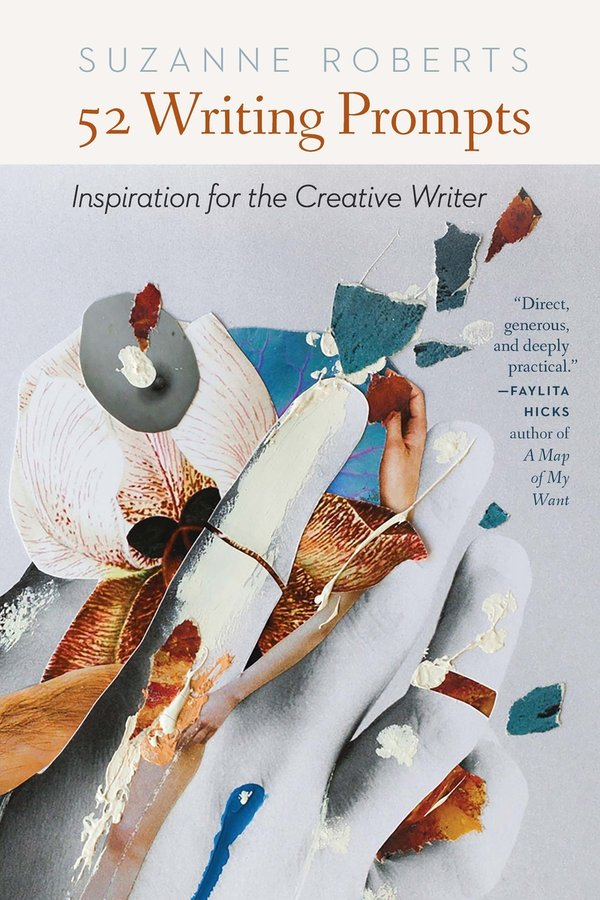 As a writer and a teacher of writing, I’m pretty sure I’ve owned, borrowed, or leafed through every book of prompts that has ever existed. An exaggeration, perhaps, but the point is that I would have sworn to you I’d seen it all before. Suzanne Roberts’ 52 Writing Prompts: Inspiration for the Creative Writer (University of Nebraska Press; Oct. 2026) proved that I hadn’t. In fact, this is the first prompt book in years that made me set it down mid-chapter — not out of boredom but because I had to go write something.
The book’s architecture is simple and browsable: 13 thematic sections, ranging from writing the body and writing environment to writing from memory and shame, each containing pep talks (“From Wonder to Nostalgia,” “How Do You know When Your Work Is Done?”) and pointed craft tips (“Metaphors and Metafailures,” “Five Tips for Writing Great Sex”). Threaded through each section are readings and writing advice from 35 writers across genres: Rebecca Makkai to Major Jackson to Gina Frangello to many other contemporary writers of poetry, fiction, and nonfiction.
Take “Tales of the Grim Reaper: Writing Death and Grief,” the section I expected least and found most immediately personally relevant. (I’m a multi-genre writer whose primary subject is grief.) Roberts frames the topic as a suitcase or backpack we travelers must carry, necessary but a burden nevertheless. Craft tips focus on ways the writer can create needful distance, from point of view to language considerations to working within forms. Roberts gathers readings and advice from essayist Kim Wyatt, poets Lynne Thompson and Didi Jackson, and fiction writer Rob Roberge – and punctuates each with a writing prompt.
One asks: “Set your timer for five minutes and write as many metaphors and similes as you can think of for loss and grief,” and from there, “Can you take one of the metaphors from your list and extend it?” I tried this on a Tuesday morning, intending to take just the twenty minutes the full prompt suggested. Almost an hour later I looked up, having generated dozens of comparisons that yielded a central image and the first pages of an essay I’d been struggling with finding a way into for a couple of months. That’s the genius of the book’s structure — we’re given encouragement, genuine craft considerations, writing examples, and advice along with a year’s worth of writing prompts to draw the material out of us while we’re not even looking.
“Conjuring Ghosts: Magic and Myth” showcases Roberts’ imaginative register. “Writers and artists know there’s a magical, mysterious force at play in their creations, she writes in her introduction, going on to acknowledge that “the worlds we create must be true in the sense that everything is possible.” The readings here include an essay of personal violence episodes braided with Lithuanian folk tales, a fictional story of a narrator who encounters her sibling’s decades-dead lover at the airport, and a poem of talismans accompanying the narrator’s father’s ghost.
The advice woven through ranges from Lidia Yuknavitch’s blunt “Make art in the face of fuck” to Ciara Alfaro’s dreamier “move through the world open to accidentally collecting pieces of story.”
The quieter sections stand out, too. “Home and Away: Writing Place” offers prompts that range from quests and journeys to the nature of home, including a prompt that motivates writers to use descriptions that have nothing to do with visuals, reminding me of my first writing teacher, a poet who excelled at sensory images. “Witnessing with Empathy: Writing the World at Large” gives writers a fun take on the classic Mad Libs game, a prompt for layering techniques, and an exercise in using humor as a way into a deep or dark topic. Contributing poet and essayist Camille Dungy’s advice to write down the stories you tell friends about an experience before memory dulls them is both basic and revelatory.
As I read, I flagged several exercises for my creative writing students and several more for myself. The beauty of the book is in its place as both a companion and manual for writers at all levels, whether beginner, intermediate, or professional. The contributor readings and advice together elevate the book from the simply useful to an extension of the wider writing community — a group of expert friends whose craft makes you marvel at their sheer skill and deep wisdom, all while including you as a valued member of the chat. The diverse writers represented here offer counsel from the pragmatic to the philosophical. Ciona Rouse’s suggestion is both: “If you know exactly where you want a piece of writing to go before you write a single word, don’t write it.”
In spirit, 52 Writing Prompts sits somewhere between the warmth of Anne Lamott’s Bird by Bird and the cross-genre anthology instinct of Janet Burroway’s Imaginative Writing in which the choir of voices keeps any single aesthetic from dominating. Readers should also know the book doesn’t flinch: sections deal frankly with the aforementioned grief and sex and shame as well as trauma. Many readings go to hard places. If using this book for teaching, some of the readings and prompts will not be suitable to just hand to younger or, in any other measure, less mature students.
The challenge to overcome whatever we need to overcome in order to slam our butts into the dang chair already and get to work will never fully go away; no book can promise that. But some books offer tools and guidance that actually help you get there faster and be more productive within that space. 52 Writing Prompts is one. My copy is not nestled on a bookshelf but sitting on my desk at the ready, spine cracked at “Tales of the Grim Reaper,” ready for another Tuesday morning. I suspect yours will find a similar home — and I suspect the pages you or your students write out of it will surprise you, arriving, as the best writing often does, when we get out of our own way and let imagination take the wheel.
 Helene Kiser’s poetry and nonfiction has appeared in dozens of magazines and anthologies and was nominated twice for the Pushcart Prize. A recovering poet, she’s the author of Topography and How to Live While Dying, a grief memoir forthcoming in fall 2028. Find her online at www.helenekiser.com.