Review by Sarah Evans

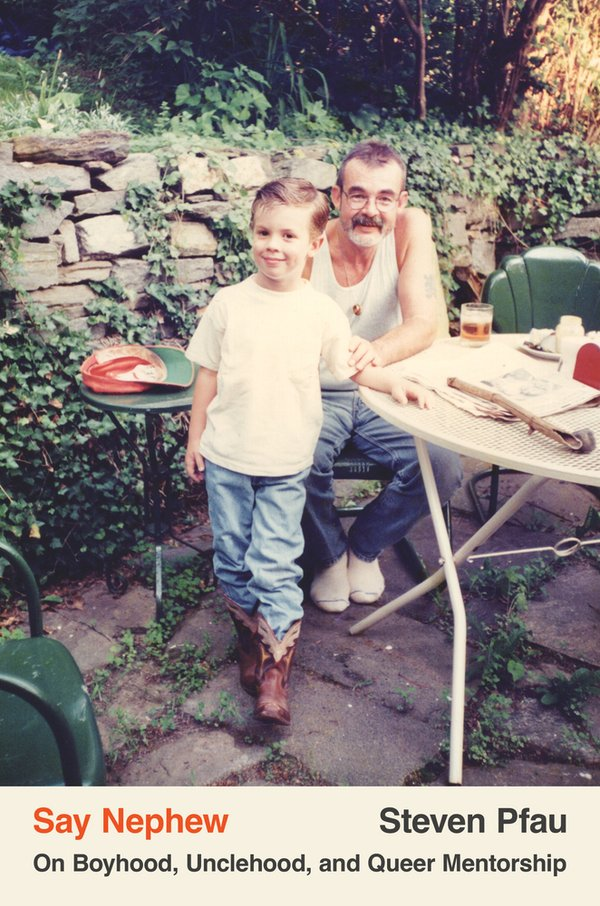 “Everybody has a gay uncle. So say many acquaintances when they hear I want to write a book about my own gay uncle.”
Soon after making this statement in chapter one of his book, Say Nephew: On Boyhood, Unclehood, and Queer Mentorship (Catapult; May 2026), Steven Pfau clarifies that sometimes his friends mean the phrase in the literal sense, and sometimes they’re only referring to a cultural trope that has become “practically a cliché, the butt of a joke.”
Pfau’s gay uncle, Bruce, was much, much more than a cliché — he was a role model, a mentor, a loving and welcoming adult who seemed to see the queerness in his nephew even before the boy was sure about it himself. Bruce was such a powerful and enduring presence in Pfau’s life that, after he passed away, the author felt adrift. “What does the nephew become once his uncle is no longer right behind him, and what stories can the nephew tell only after his uncle is gone?” Pfau asks.
At its heart, Say Nephew is the memoir of a young queer man attempting to navigate his identity without his father-like gay uncle there to continue guiding him. But the book is so much more. It’s an analysis of uncles and nephews in literature, a pondering of what “uncle” and “nephew” mean in gay culture, and an exploration of the importance of elders to young queer people who are still figuring out what their newfound identity even means.
The loving portrait Pfau paints of Bruce makes you wish he was your uncle, too. He was an outgoing, charismatic man who told jokes and lit up every room with song, dance, and showmanship. Nothing in his home was off limits to his young nephew. When Pfau first started asking tentative questions about gay identity and culture, Bruce always answered honestly, often with a quip, and never with any sense of embarrassment or shame.
Despite feeling so close to Bruce, Pfau frequently laments that he doesn’t have the same charisma in his own relationships. He goes to the same gay bar multiple times a week and still finds that the other regulars don’t recognize him. He struggles to tell a crush that he feels more than friendship between them. He stumbles his way through figuring out the proper way to arrange meetups with other men through hookup apps.
Eventually Pfau finds himself gravitating toward gay elders, older men who in some ways take the place of Bruce by sharing their lives, their homes, and their insights from years of experience. Pfau begins to realize that Bruce’s role in his life did not happen only because they were related by blood, that queer mentorship is a unique relationship many young gay people find outside of their family tree.
Pfau’s book is an honest, tender-hearted, intimate exploration of how important a supportive and loveable gay uncle can be to a child figuring out his own identity. But it’s also a powerful look at how influential one generation can be on the next, particularly when both identify as part of a culture that is too-often shunned instead of embraced. One can only hope that every gay young person finds their own Uncle Bruce to keep the light on as they stumble their way through the dark.
Sarah Evans
ReviewerSarah Evans is an Oregon writer and social justice activist who tries to raise marginalized voices by reviewing books written by and about people of color, women, and those who identify as LGBTQ+. She has an MFA in nonfiction writing from Pacific University.