
Reviewed by Sayantani Roy

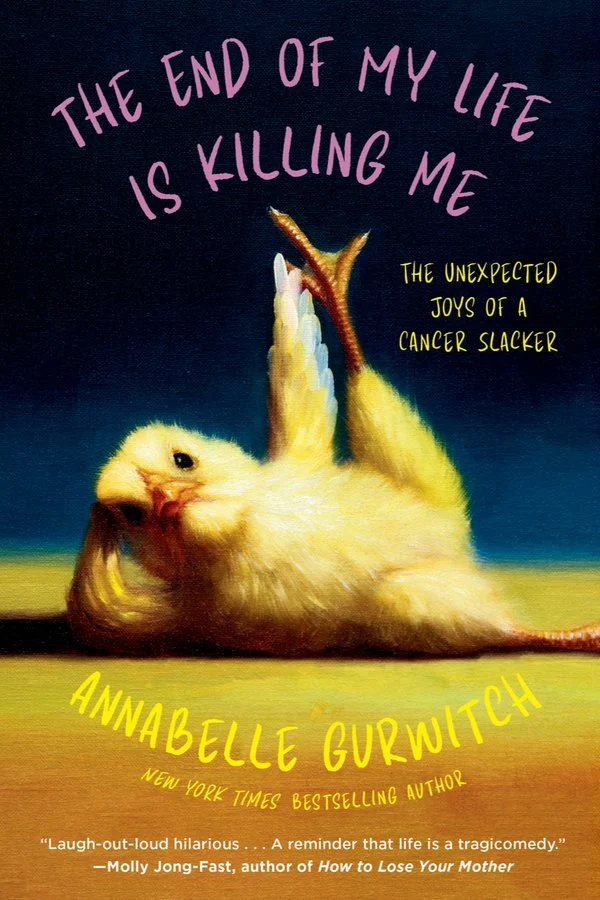 Annabelle Gurwitch doesn’t beat about the bush. The first line of her cancer memoir, The End of My Life is Killing Me (Zibby Publishing; March 2026), states straightaway that she got slammed with an out-of-the-blue stage-4 cancer diagnosis. The cover displays the lighthearted subtitle, “The unexpected joys of a cancer slacker,” and an image of a duck doing a Pilates side kick with its webbed feet.
Funny cover notwithstanding, the book isn’t about a Pollyanna-ish approach to cancer. Among the “tsunami of decisions” she contends with upon diagnosis, the one that Gurwitch takes most seriously is to adopt a “cancer persona.” When she meets her “angel,” a mentor in the cancer journey and a cancer patient like herself, Gurwitch tells her that she intends to shun the ribbon, religion, and runs. Nor does she want to be a warrior or a survivor, or even a sexy cancer vixen.
She vows to become a cancer slacker instead, which is to say, she wants to eschew any kind of “performative indefatigability,” and the only criterion for the “after life” (as in after diagnosis) is to make choices out of her comfort zone. One outcome of that mindset is this book, which is as funny as it is serious and is chock-full of practical advice offered through a detailed and unsentimental recounting of her experiences. It is an ode to patient advocacy and showcases her gifts as an activist, public speaker, humorist, and writer. Gurwitch is no slacker when it comes to telling a good story. As a bonus, she tells this like a friend, albeit a whip-smart and well-read one. Parts of it might make you cry, but you are sure to guffaw your way through it, just like she intends to do on this journey.
Her introduction is not one to be skipped. I learn about zozobra, a Spanish word for shipwreck, coined by Mexican philosopher Emilio Uranga, which gives Gurwitch the apt vocabulary to describe the “precariousness” she felt as an asymptomatic patient, freshly handed a terminal lung cancer verdict. I also learn about her embracing of French author Georges Perec’s “infra-ordinary,” which means to “defamiliarize the familiar” in order to seize the day, although she tells us straight-facedly that it is indeed possible to “carpe too much diem.” She takes inspiration from Henri Matisse, who, diagnosed at seventy-one with a terminal disease, created the famous ‘Blue Nudes’ during the period he dubbed his second life. In communion with him, Gurwitch unleashes her “real self” in the “after” and leaves no stone unturned to get the best possible treatment, put her finances in order, and above all to live with purpose and joy.
In talking about how a COVID-19 test and related chest X-Ray led to her initial diagnosis, Gurwitch quotes Gertrude Stein—“There’s no there there” in California. She’s of course talking about the labyrinthine highway arteries that she traversed to get to the clinic, but she’s also cannily seeking the reader’s acknowledgment of this fitting metaphor for the muddled pathway of the cancer journey. She includes entire dialogues to let her readers in on the shock that left her crying “until the sun set.” Her cousin Ruth and friend Juel refuse to say “cancer.” “The doctor says it’s adenocarcinoma,” insists Ruth. After confirmation, Gurwitch calls Juel in mock triumph: “Guess who was right? I have lung cancer. I win!” Even in sorrow, Gurwitch is funny.
Diagnosis, “haggling with insurance,” and immediate side-effects of the biomarker targeted therapy (“little paper cuts on fingertips and nail beds”), all take a toll, but she can’t help wax poetic about the etymology of Fatigue, which for her, thanks to the phrase “Je suis très fatiguée” she learned in middle school, “conjured an image of loucheness” and reminded her of Ophelia, “fetching,” even in death.
She chronicles the “calamity of kindness” from friends, who gift her with a slanket (blanket with sleeves), offer to launch a GoFundMe campaign, and rope her in for a supporting role in a Michael Bay movie. She starts dating a former music executive, Jeremy, with his “rakish, Daniel Craig-ish good looks,” and whose accent—a mix of “imperious British lilt tempered by the salt-of-the-earth sturdy twang”—she describes with meticulous, almost poetic detail. It’s these delicious digressions that make her memoir what it is—vulnerable, intimate, and exuding a best friend’s warmth. They also show that life is what you make of it, cancer or not.
Instead of Why me? she explores the How? of her journey. She comes at it by way of Beckett. “When Beckett becomes relatable, you are in dire straits,” says Gurwitch, citing his inscrutable line from Texts for Nothing: “I can’t go on. I will go on.” She emulates the German concept of the “regulars’ table” by launching the “Sunday friends Stammtisch,” a regular get-together with friends with whom she shares a steady bond. The Stammtisch holds steady, while the music band she tries to recreate by getting together with old friends on Zoom doesn’t quite take off. Her marvelous line “We were terrible and we were magnificent” describes that push and pull of fracture and closeness. The “Flowers of Algernon” gets disbanded and the “silly and sacred memories” remain, although the who-said-what and who-did-what get blurred. Memory, in this journey, often turns out to be a fickle but endearing trickster.
Each chapter reads like a complex, braided essay, replete with lovely meanderings, but the best one may be “I’m with the Band,” the longest chapter, which exhibits the narrative urgency, surprise, and trajectory of an elevated work of fiction. Stable for twelve months, Gurwitch’s embarking on a tour to Europe with a fledgling metal band truly inducts her into the pavilion of ultimate cancer slackers. She does everything she must not do. For three to eight hours each day she “rides bitch” in a van, which means being sandwiched between the driver and another musician, and sells merch for the band when the only thing she knows about heavy metal is that a Metallica number was used by the CIA as a torture device.
Cancer surfaces only in mentions of her medicine-induced flatulence and the contents of her suitcase, which, “between the lingerie, lubes, and assortment of pills… looked like one that belonged to a sex trafficker.” After all, “I do have to sleep with the manager,” she tells a person who is awestruck by her spirit. Will she get to experience Paris the way she intends to? Will the band members acknowledge her, this beautiful older woman who feels both maternal and hyper-conscious of her femininity in the presence of these twenty-seven year olds?
We root for Gurwitch, who has tried everything, from making a BFF out of her pulmonologist to the annual observing of UOP or the “unfurling of (wall)paper,” and one who exhorts her readers to “institute small gestures that add beauty,” but tells them she might be miffed if they label her décor as cottagecore. Gurwitch is the true balabusta (Yiddish for ballbuster), the words she uses to describe Demeter when, at one point in her journey, she felt she needed a “staunch advocate” by her side.
She becomes her own Demeter though, and through living life intentionally, she continues to be a Demeter to many others. Her memoir is just more tangible proof.
 Sayantani Roy works out of the Seattle area and has placed work in Emerge Literary Journal, Heavy Feather, Grist, Mayday, Timber, West Trestle Review, and elsewhere. She is an MFA candidate at the Rainier Writing Workshop, and her work has been supported by AWP and the Jack Straw Cultural Center. See more at: https://linktr.ee/sayantaniroy.