
Reviewed by Emily Webber

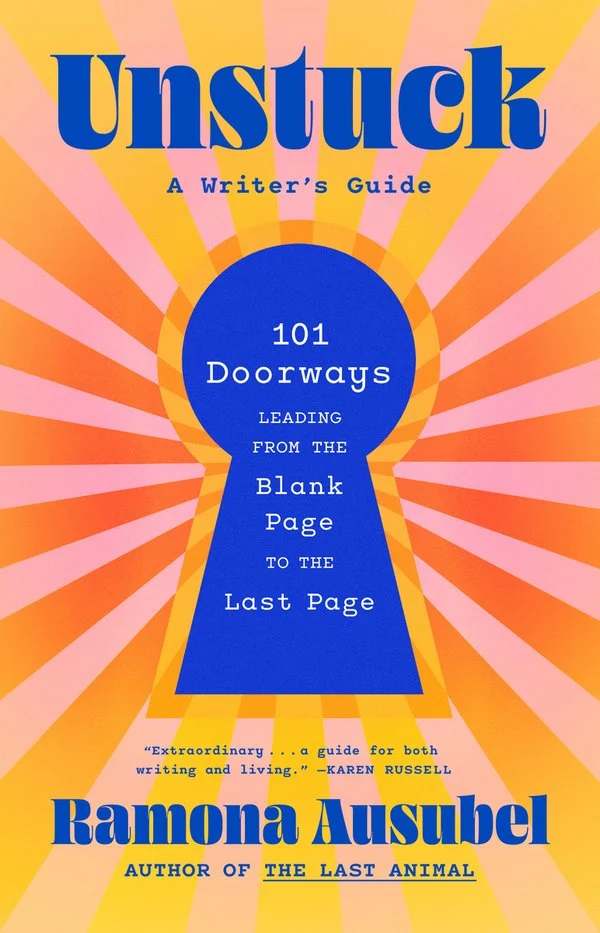 In her craft book, Unstuck: 101 Doorways Leading from the Blank Page to the Last Page (Tin House; April 2026), Ramona Ausubel offers writers a framework for maintaining forward momentum without getting bogged down by rigid rules.
Instead of focusing on strict outlines or formulaic story structures, Ausubel organizes the writing process into four distinct phases. For each phase, she presents metaphorical “doorways” and practical “takeaway keys” designed to shift the writer’s mindset. By encouraging writers to treat their work as fluid, exploratory, and open to surprise, Unstuck prioritizes creative discovery over predictable construction.
“There is so much emphasis in our culture on the two ends of the creative process: the spark of inspiration and the neatly packaged finished product. Rarely do we talk about how to be in and appreciate everything that happens in the middle when in fact the middle is where most of the actual work is.”
The book’s early “doorways” push readers past the surface of an initial idea to uncover additional creative possibilities. Instead of fighting fear, confusion, or writer’s block, Ausubel urges writers to lean into the messiness of experimentation. Through brief insights and practical exercises, she helps a writer move beyond their initial writing on a new story idea and discover unexpected directions for their project. An important mantra she repeats in the early pages, one I always need to hear, is:
“It’s not supposed to make sense yet. It’s not supposed to be a book yet. I am discovering something still unknown on this earth. Create energy. Repeat.”
It serves as a reminder that something even more magical might be awaiting us beneath our initial ideas.
Recognizing that authors often write in the middle of the chaos of daily life—balancing childcare, chores, and full-time jobs—Ausubel designs her methods to be highly manageable. Her practical exercises easily fit into short daily blocks of time. This accessibility is matched by her conversational, informal tone, which makes the guidance feel less like a dry lecture and more like advice from a supportive friend.
While reading Unstuck, I gathered specific exercises and approaches to the creative life that I will use every time I work on a writing project. One is to keep a notebook with details you notice throughout the day. I now try to write down a specific detail every single day. Like the one I wrote down a few days ago: in the park, there’s a serious-looking man holding a small whiteboard with a checklist of items on it while walking with his son. Noticing and writing down this detail helped me find a way into a story idea I’d been thinking about. Overall, the practice reminds us that narratives need to live in the concrete details rather than remaining vague, big-picture concepts.
The second exercise I’ve adopted is cutting up my drafts—removing entire sections increment by increment and completely rewriting the story with only what is left. By saving all these excised fragments, I can revisit them later to spark entirely new projects.
This is what makes Ausubel’s book so valuable: it offers a treasure trove of creative strategies that push your writing in unexpected directions, opening up a story rather than closing it off.
 Emily Webber is a writer of criticism, fiction, and creative nonfiction. Her work has appeared in Rain Taxi, the Ploughshares Blog, The Rumpus, Writer magazine, America Magazine, and elsewhere. She’s the author of a chapbook of flash fiction, Macerated.