

I’ve relocated to a place where the mountains disappear.
Four days’ drive from the 23 years spent teaching on the Texas border. Maybe if you’re from Snohomish County, or somewhere like it, you already know mountains can disappear. But if you grew up in the Midwest—on the south side of Chicago—you assume things that tower over you stay put. Like the Sears Tower. Like the Chicago Motor Club Building. I worked in both—teller in one, mapper in the other. Both have since been renamed, but after my time.
There is an advantage to vaporizing. Here, I’m incognito. I feel certain I won’t run into anyone I know. No colleagues or neighbors, or friends from the South Texas dog park who might have happened upon my mugshot and want an explanation—but won’t ask because they don’t want to be rude. This only makes it worse because then I think everyone has seen it, but nobody is saying.
I know it seems I need to explain the facts of how I landed in jail. But you will see they matter least, as mundane as the too-hot cup of coffee cooling beside me as I waited to move over in traffic. The blur of a car swerving into my path, way too close. Hitting my brakes hard enough to lock the seatbelt.
So, even as I lean toward self-defense—toward persuading you with detail—I strip the plot points down to their smallest components. A wayward haiku intent on distilling the story to its bare essence, without the line constraints.
A man’s car swerved into mine.
I didn’t feel it.
I left to buy my dog food.
I was arrested.
I pause the haiku here—not to elaborate, but to question my own plausible-deniability argument. Is it possible for a car to graze another so lightly you don’t feel it?
You say, no—I’d notice the impact.
But then you remember the time a pickpocket emptied your wallet on the “L” in Chicago, and all you recall is ignoring the sound of coins scattering across the train’s metal floor. So maybe contact can go unnoticed. Maybe brakes slamming, a horn blaring, adrenaline flooding your body—and the retractable design of modern bumpers—can obscure the impact, entirely.
And so you drive away.
Back to the poetry.
A cop at my door showed me
scuff marks on my car.
Ten days passed. He called again:
“Surrender,” he said.
The lawyer I’d never met,
said, “wear something warm.”
So I did.
***
It’s such an ugly mugshot photo. Anything beautiful, or admirable, humorous, playful, or interesting is absent, as if those attributes were as transient as my youth and have likewise abandoned me. What’s left is the swollen tissue beneath my eyes, the creases, the blotchy skin. Disdain. Loathing. I look like a criminal, exactly what you expect of a lawbreaker, the kinds of people who steal and murder and assault.
We all look the same standing against that backdrop.
“No smiling, take your glasses off, look straight ahead, turn to the right, to the left. Place your eyes up against this machine.”
Instructed by people who wear khaki uniforms and side arms, your eyes—like your fingerprints—are scanned, captured. The flecks of gold in your sage green irises, inherited from your cop father, are no longer a tribute. They’re data. Evidence for the next crime you are sure to commit. No reason to wait for a conviction. No reason to delay publication of your mugshot on the internet of eternity.
But they ask you for more. Any tattoos or piercings?” I consider telling this woman I have a giant pig tattooed on my ass, but refrain. “No,” I say, but actually this is a lie. I have a tiny star on my ankle, matching my two oldest daughters, a vacation indulgence—or more accurately a parent succumbing to her teenage girls’ relentless insistence. God, that hurt. And on my calf, there is a sweet Great Dane sitting behind a single flower: a remembrance of my Moby. Pieces of evidence the criminal justice system will not be diagramming and cataloging.
They did get to feel my 60-plus-year-old boobs—post three kids and two reconstructions. They got to run hands up my thighs to my crotch. They didn’t get to bend me over to peer into the dark places—that level of degradation is meant for those who don’t make bail. Jail changes you. Depletes you. Melts the mountain of your being.
When the Taylor Swift clone —her charge was theft—stole the three-inch pen they gave her to sign the processing forms, I was elated. No—I was elevated by her defiance. I was rooting for the criminal team now. My team.
The women passed the pen around, used it to write phone numbers of friends and attorneys—maybe dealers, for all I know—on skin and clothing. There was no paper. Only arms, palms, hems, ankles.
I already had my girlfriend’s and attorney’s numbers written in ink on my leg, just below my Moby—I’d written them down before they confiscated my phone. I suppose the thief could have used the pen to stab someone, gouge out an eye. Maybe she didn’t think of it. Or maybe she was something else.
The obvious metaphor with the mountains is that you know they are there even if you can’t see them. Somewhere I was a full professor, a devoted mother and grandmother. A disability researcher. A short story writer. An artist.
They had this whole fucking thing wrong. I was a pillar. Right? Not a criminal.
I was sent to city jail—
handcuffed and shackled,
searched and fingerprinted.
A professor doesn’t know what to wear when she’s ordered to surrender, so she chooses a white linen jacket, a navy button-down, black pants, new white socks, gym shoes. She doesn’t know shoelaces are not allowed. She doesn’t watch CSI. She doesn’t know how to walk in shackles and cuffs. She thinks maybe head down, eyes on the floor.
Instead, you lift your chin—walk the way you will at next week’s graduation, the Mariachis playing “Pomp and Circumstance.” You hope you’ll be there to hear it.
From the shore of Puget Sound, when the mountains are replaced by layers of sunken clouds, you imagine you see the hidden peaks. A map app has told you their names. The Twin Brothers is the one you remember, and you press your brain to find it. But the shades of gray bleeding into one another remind you of your own too-wet watercolors. Are those the brother peaks? You want to name them. But why?
Fingerprinting is nothing like you remember. In grade school, your science fair project was a hit—inking your classmates’ hands, your teachers, even some of their parents. Did you win a ribbon? You can’t remember. Your cop father taught you how to press each finger into the ink, how to roll them onto a cardboard square divided into labeled boxes. How to name them—arches, loops, whorls.
And you remember the one teacher with no prints was Mrs. Story. You don’t think she burned her prints away to hide criminal behavior, but who are you to underestimate her? She was the first person to get you thinking about becoming a teacher. You wanted to roll chalk in your hands the way she did. Hear the click, click, clicking sound it made when passing over her wedding ring.
I was arraigned, bail was set.
Shackled and handcuffed.
Transported to county jail.
Eyes scanned, fingerprinted again.
It’s when we walk in a line, with our hands clasped behind our backs, to the processing room, that I find out fingerprinting is done by a computer program. Some type of scanner. And the people who position your fingers and press them onto the glass are young women in guard uniforms with attitude—the age of my students. They speak no words signifying respect in this process. Place your hand on the glass. I correct her with a “Please” as if she were a child needing a lesson in politeness. But I can hear my sarcasm, and I suspect she can too.
Graf, she calls me.
Not Dr. Graf or Professor Graf, my salutation for the 23 years I taught on the south Texas border. I’ve heard my students call us by our last names. “Can you believe Graf assigned a 20-page paper on living with a disability?” But this is familiarity, not the kind of disrespect that breeds contempt. When they transition me to the mug shots and the jailer-in-training forgets to tell me to take off my glasses, I say nothing; the five other women say nothing, knowing the wannabe guard will need to start over. Not caring that it increases my discomfort to be ordered about under the blinding lights.
Don’t smile, they say. It’s not a smile. It’s a smirk.
My professor is gone, my mother, my grandmother, my disability rights advocate, my artist, all left to wander somewhere unseen. I meet my criminal.
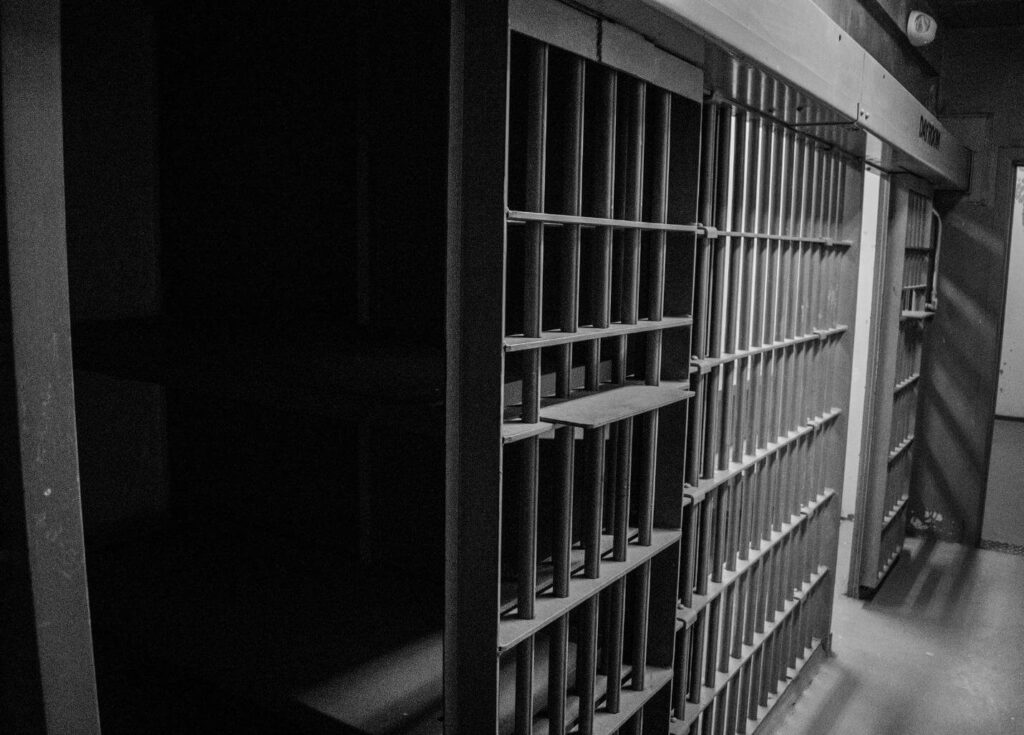
In a locked cinderblock cell
without a window.
Twenty-two hours later
I’m released to the street.
There it is. The story without its adjectives.
***
You might think this is about me and my captivity following a false arrest—about injustice, shame, humiliation, intimidation, defiance. That would probably be enough for an essay.
But I’m not alone in this 15-by-10-foot cinderblock cell. I’ve counted the blocks dozens of times. It’s smaller than it sounds once you subtract the square footage taken by the open metal toilet and the sink attached to it.
The statistics professor in me starts doing the math: sixteen women in roughly 120 square feet means about 8.4 square feet each—less than a three-feet by three feet-of floor space. It means I can’t stretch my arms without touching someone. I can’t take two steps.
So, I stay upright in my spot.
Around the perimeter is a 6-inch-tall cement step. On it, my fellow inmates lie and sit, backs against the walls. The most coveted seat is the toilet—as close to a chair as it gets. Another woman perches on the sink behind it, knees pulled up, the stream of constantly running water making it look as though it’s pouring from between her legs. This could be funny. But it isn’t.
When someone needs to pee, those seats are vacated. When someone needs to take a crap, she keeps flushing to muffle the sound. There’s no masking the smell. There’s no soap. You can wet your hands but then you wipe them dry on your clothes. No paper towels. The toilet paper rolls—tossed in by an unseen hand when the metal door slides open—double as pillows until they’re needed for their intended purpose.
Water comes only from the shallow sink above the toilet. If you’re thirsty enough, you lower your face into the dirty sink with the constant outpouring. No cups. Only one woman succumbs to dunking her head to get a drink.
Without a chair, I stand—five hours in city jail, eighteen more in county—refusing to sit on the filthy floor. When the other women notice, I tell them, This is disgusting. This is no way to treat people. I sit only twice: once on a bench in the fingerprinting line and once in the van between facilities.
The women keep offering to make space, patting the ledge, telling me to sit. But when one woman says, “You stand your ground,” I know I won’t sit again. To sit would feel like surrender. So, I stay on my feet.
I go without clean water for eighteen hours. Each time the metal door opens to bring someone in or take someone out, I ask for water. After the fifth ask, they take me to a fountain with orange and black mold crusted around the spigot. I don’t drink.
After twelve hours without food, they bring trays—five gray partitions holding what looks like variations of the same thing: all white, lumpy, cold and shapeless. The Taylor Swift thief pulls a long black hair strand from her macaroni and cheese. I drink the child-sized orange juice in two swallows and refuse the tray.
Complaining about the water and the food will cost me. I am the only woman in the cell who never receives a phone code, necessary to make use of the phone in our cell.
I am not the oldest woman in the cell.
Aggravated assault with a deadly weapon.
She’s seventy-seven. Says she shot an intruder with rubber bullets. I believe her. Later, I look her up her mugshot and see it was a neighbor she threatened, and the gun was loaded.
Credit card theft.
The Taylor Swift look-alike. Married, kids, teaches school. She ordered a bathroom cabinet and towels using a student’s credit card. Tried to return them, but the student’s father is a detective.
Medicaid fraud.
A grandmother, thick grey hair, uses the wall phone to instruct someone how to care for her grandchildren. She apologizes to everyone, in Spanish, for taking up the line.
Probation violations.
Several women “blew hot” on court-ordered sobriety tests. They know each other, pass around stories like gum. One sells pot baked into pastries. Anyone interested?
Assault.
A woman with a raspy voice and a laugh like gravel says she scratched her boyfriend’s ex outside the courthouse. She claims she dates a cartel member. Maybe she does. Maybe she doesn’t.
Possession of a controlled substance.
Too-thin. Dolly Parton hair. She went to Mexico to get a tooth pulled, came back with Trazodone. Her husband crossed with something stronger. Her speech is slurred, jaw swollen.
Delivery of controlled substances.
Two girls, still teenagers. They plead into the phone, begging their mothers for bond money. One mother says yes. The other doesn’t have it.
Obstruction.
A military woman. She stood too close while police were arresting her friend. Didn’t back away when they told her to go. She can’t believe she’s here.
Collision involving damage to a vehicle (Hit and run.)
Me. Though in reality it’s leaving the scene of another car hitting mine. Verified by an insurance investigator.
Not everyone says why they’re here. Some speak only Spanish.
One woman lies curled on the floor, lactating through her shirt. She asks for sanitary pads.
Another wears a t-shirt that reads TRUST NO ONE, the letters cracked and peeling. She has nothing more to say.
The last woman they bring in arrives in a wheelchair. She tells the guards she has metal rods in her legs. They lift her by the armpits and drop her onto the concrete ledge. She groans. Hours later, when she makes bail, the guards order the inmates to help lift her back into the chair. I’m guessing no one here is trained to move or position a disabled woman. I neglected to teach my students that the Americans with Disabilities Act doesn’t apply in jail.
I give the old woman my jacket because she is shivering. It’s far too big for her and she wraps it tight and lies back on the concrete floor. White was a bad choice; it will never come clean. Still, something returns to me—not justice or dignity. but a pulse of humanity. A thread of camaraderie with these women.
The mountains haven’t disappeared; they’re only hidden, layered beneath fold over fold of low-lying clouds.
After twenty-two hours, they hand back my phone and release me into the street at 5 a.m. I stand with a dozen others—women and men—suspended under the streetlights. Uber won’t come. Lyft wants $125 to go seven miles. Three people climb into my ride. One of them, a man with tattoos climbing his neck, says he just finished twelve years. When we pass my university, I say, I teach there. He laughs.
Is it a joke? Why did the professor take a Lyft with a bunch of criminals? Was it to get to the other side?
In the rock-paper-scissors game of despair, contempt, and indignation, I keep leading with despair. Two court dates and thousands of dollars later, I am released, ‘In the Interest of Justice’. But the case isn’t lucrative enough for the civil rights attorneys I contact. No one died.
Mountains appear at midday,
crisp snow-capped clarity.
And I can’t bear to look for long.
They are too stark.
 Noreen Graf is a writer based in Washington state. Her work has appeared in Electric Literature, Reckon Review, MER Literary Review, Ocotillo Review, Dirty Chai, Political Irony, and Oyedrum, with new work forthcoming in BULL. She is a Pushcart Prize nominee and has been a finalist for the Solstice Literary Fiction Prize and the James Jones First Book Award, and runner-up for the Chester B. Himes Short Fiction Prize. She holds an MFA in creative writing from the University of Texas Rio Grande Valley and taught for more than two decades on the Texas–Mexico border.

Wow! What stunning writing. I’m so sorry you had to go through that.
Thank you Mary. So kind of you
SUPERB and deeply moving. This piece is perfection. Yes, perfection does exist. It tore me to pieces – not just the story, but also, ‘how’ it was composed – how it was told. So now, I will disappear like those mountains, and tend to the task restoring myself.
“…leading with despair….”
A tight, diamond-hard session or stay in Modern Hell where the coldness of concrete, the nauseating attributes of food and water, and the abrupt and inexorable workings of the gears and levers of criminal justice all conspire to give the reader a waking nightmare.
Wow. Honestly one of the best things I’ve ever read. Especially about a brutal and broken system. How terrifying and also inspiring (with that bit of defiance)…I will be thinking about this one for a while.
An expertly crafted piece on the brutality of a system that strips people of dignity, the dissolution of privileged distance, and the shared humanity revealed through that dehumanization.
Thank you Rory!