Interview by Melissa Fraterrigo

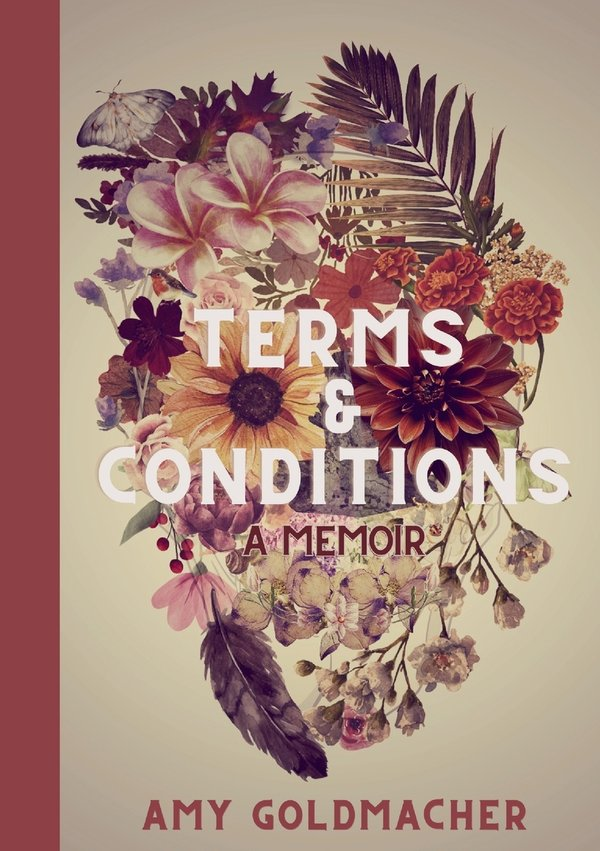 As the nonfiction landscape evolves, hybrid memoirs continue to capture the fascination of readers and writers alike. To learn more about this form and be inspired by its possibilities, I encourage you to check out Amy Goldmacher’s Terms & Conditions: A Memoir (Stanchion Books; Oct. 2026), a hybrid collection that is part memoir, part artifact, and part research.
When Goldmacher arrives at the same age as her father was when he died of pancreatic cancer and learns that she also carries the same genetic risk for the disease, it sends her on a journey to explore themes of anxiety, inheritance, death and love.
Through the process of writing she ultimately discovered the glossary form, and this structure cracked open the book for her. As an anxious person, Amy discovered that she couldn’t “separate the questioning and analysis from the writing,” so the book offers insight not just into her process, but also her person. The result is a quick read that offers a thorough interrogation that will remain with you long after you conclude the book.
I recently spoke with Amy about her book and her writing process; our conversation is below.
Melissa Fraterrigo: Terms & Conditions is a hybrid collection: part memoir, part artifact, part research. I’d love for you to discuss the evolution of the book. Did all the essays come together over time, or did you have a particular vision in mind?
Amy Goldmacher: I distinctly remember thinking in the beginning that I would write David Sedaris-style essays, and it would be great. That’s not how it went at all. The hubris! I started writing in a linear fashion, chronological, starting with childhood: here’s what happened to me. Once I got about twenty pages into it I shared it with some writer friends who basically said, “This is boring.” They were right. It wasn’t really engaging and it didn’t really have stakes, but I was also living it while I was writing it.
In 2019, I was turning the same age my father was when he was diagnosed with pancreatic cancer. I thought, “Well, I should probably have a genetic test to see what kind of risk I have.” It felt really important at that moment because that was kind of the beginning of the end for him. I felt like I should probably try to avoid it if I can by identifying any risk that I might have. So that added a new dimension to the story that I didn’t know was related. The results of that genetic test became another thread that I would end up writing about.
At the same time, while I was writing, I kind of tore apart what I had to see if I could figure out what I was actually saying. I asked myself: what am I really writing about? What is each little bit about? And I put in a spreadsheet a keyword and a description of that keyword. And sorted it by alphabetical order to make it easier to read. And suddenly it became really interesting.
Once I saw it in alphabetical order and by keyword, new possibilities opened up. I could see that it didn’t have to be chronological, and it could go from topic to topic and be more associative, with one piece leading into another without it being in chronological order. That made it easier to write new bits to fill in some of those gaps. Once the structure emerged, then I had a vision that I could execute. There was something really magical about that structure emerging because I had no idea when I started that this would be the direction I was going in, but I was really interested in it and fascinated by it. I think that helped sustain the writing of it and bringing it into an existence.
MF: So many of the strands of this experimental glossary-form memoir are apparent on page 1 : You are anthropologist. You are a fatherless daughter. You have a genetic mutation. You have chronic anxiety. But then you go on and pose this question that serves as sort of directive for the book: If you could observe enough patterns, you would be able to figure out answers to your questions: why do you do the things you do? How did you get to be who you are? What will be your fate? Can you discuss your thinking process?
AG: This was another learning moment for me as a writer because we’re told that we don’t need to give the reader a lot of backstory or context before getting into the story. As the writer, I wanted to make sure that these identities were foremost on the page and the reader would know this is what the story is about. There definitely was tension around “should I have even put that in there?” but it was important to me as both the writer and the main character of the story to put forth and interrogate these identities. And looking back on it now, several years after completing writing it, I can see that this is my voice, my style: I can’t separate the questioning and the analysis from the writing. It is part of who I am.
MF: Was there a piece that was especially difficult to write from an emotional standpoint? And what about from a craft standpoint? For example, “ANXIETY III” is 2.5 pages in length, but is comprised of one beautiful sentence. I wondered as I read it if this structure made itself known to you from the first draft.
AG: Thanks for saying that about “ANXIETY III.” That was definitely intentional because I knew that that was the feeling of anxiety: it’s just one long sentence, words tumbling out after another. I knew that the words and the piece had to convey that feeling of being not in control, it’s spilling out of me. That was another craft lesson I learned in the process of doing it: the structure of the piece could do a lot of heavy lifting for the content.
And I think, in terms of craft, writing this book taught me the difference between telling somebody what happened and showing somebody what happened. I could really focus on being in the moment in short pieces. I had to time travel to go back and live in those moments again, which was emotionally difficult for some of them, especially the ones about anxiety and my father’s death. I had to go back in time and put words to what I was feeling then. I definitely didn’t have the words at the time.
MF: We learn that your dad is a member of ARRL (American Radio Relay League) and a licensed ham radio operator and that your husband also hopes to study for and take the test for the ARRL. Later such connections deepen and we see how such similarities extend to your relationships. I’m thinking of “CRUISE,” and how one week into this three-week trip of a lifetime, we see that you are having a less than ideal experience.
You say: “Your enjoyment depends on your husband’s mood, and your stomach clenches, navigating the decisions of what to do and potential consequences. That is the tradeoff: a pre-made plan removes the responsibility for his good time from you; going off as a couple means he gets to sleep in, but there is no guarantee the day will go smoothly.”
At what point in the drafting process did such connections between your father and husband become obvious? How did writing these essays change your understanding of your roles as a daughter and wife?
AG: There was a moment in real time in my life in 2020, while I was in the early stages of writing the book and also coming out of a period of extreme anxiety. My husband and I were planning to go to a wedding in India. He was trying on his outfit, including the dress shoes that would go with his tuxedo for this black-tie wedding. The sound of dress shoes on a hardwood floor brought me back to my childhood, hearing my father going to work in his business suit and dress shoes.
That was the moment I realized that my present anxiety was deeply connected to my anxiety from my childhood and my relationship with my father. That was the moment in real life where I understood there’s a reason why I’m feeling anxiety now. It comes from childhood. That was the moment where I realized that I needed to separate what was happening in the present as an adult with my husband from my childhood emotions and memories. So that realization and that moment had to be worked into the book, and that is the transformation of the narrator.
That was one of the pieces where I had to play around with the title so that, in the alphabetical order of the book, the moment and the meaning of the piece were very deliberate and intentional and meaningful to the arc of the story.
MF: The book seems to be a great deal about anxiety, grief, and making peace with the unexplained. In what ways has the book assisted with your own journey?
AG: I wanted to bring the reader along with me on this journey of self-discovery: I was a person who carried a lot of stuff from the first half of my life. We all are! I was facing major milestones in terms of my father’s illness and death, my own health journey, and approaching 50 and the mid-life point. I wanted the reader to see what it was like to make that transition from the first half of life to the second half of life. Writing it helped me make sense of it for myself. I asked myself questions and came up with an answer for myself that is enabling me to move forward into the rest of my life and let go of the stuff that I don’t want to carry anymore.
MF: As someone whose loved ones are living with chronic conditions, your anxieties regarding your genetic mutation really spoke to me. How do you hope this book adds to our understanding of the illness narrative?
AG: The idea of liminality was really appealing to me in the early stages of writing this book, because it’s a concept that can be wrestled with anthropologically speaking, and because it spoke to me in real life because I was in between the first half of my life and the second half of my life. I was in between having an illness and not having an illness. I feel like a lot of people are caught in these in-betweens, in between one thing and another or one phase and another. I wanted to bring that to light a little bit for people who might be navigating an in-between space where they’re not one thing and not the other either. When there’s not a space for you, you often feel invisible. People who, like me, have the risk but not the illness, may feel like there are no resources for them or that they don’t fit in the category of the sick or the well, and I wanted people to know they are not alone.
MF: The use of artifacts adds a tactileness to Terms & Conditions. I think one of my favorites is your father’s puttanesca recipe, crumpled paper and all. How did you choose what you chose to include? Were there any primary sources that ultimately did not work in the book’s final iteration?
AG: Luckily, my mother kept a lot of my father’s stuff. Stuff that lived in boxes and survived multiple moves over multiple decades. So I got to go through what remained, and it raised questions: why did this bit of work correspondence get saved? Why these photos or toys? I think it was the pieces that I had the least answers for were the most interesting for me, and creating the best or most likely answer gave me a bit of closure.
Of course, there’s lots of stuff that didn’t make it into the book that I can revisit. There’s actually one thing from my childhood that I found recently that gives me new insights into my childhood and my father. I’m going to make a little video about that because I think it would be an interesting complement to the book.
MF: You are an anthropologist as well as a writing coach. Can you discuss how your background influences your creative process?
AG: I’m starting to see the connection between being an anthropologist and being a writer and coach more now, especially when people who read the book or work with me reflect back to me that they see the influence of social science in my writing style and in my coaching style. It didn’t occur to me that my creative writing would be so heavily influenced by my background as an anthropologist, but it actually feels really good to think that those two disparate parts of my life aren’t disconnected from each other. That I am a whole person who integrates the good and valuable parts of my past into my present and future.
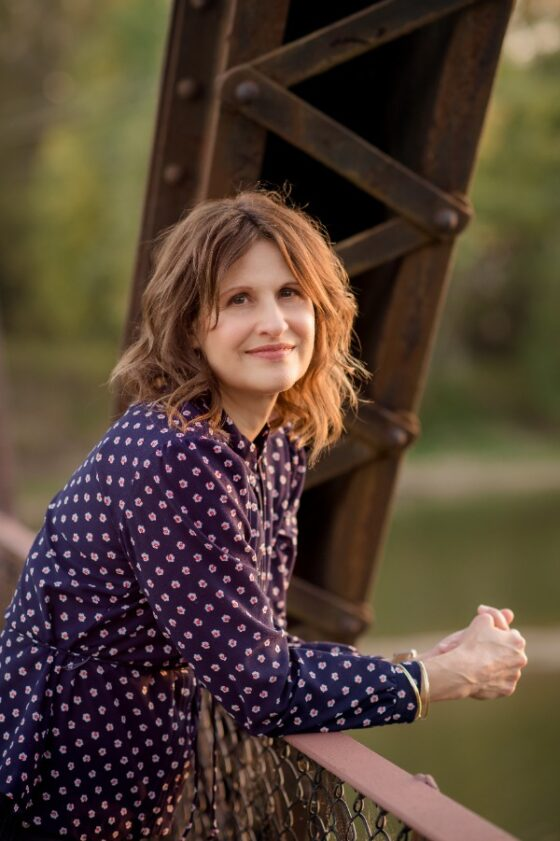 Melissa Fraterrigo is the author of The Perils of Girlhood (University of Nebraska Press; 2025), the novel Glory Days (UN Press; 2017), and the short story collection The Longest Pregnancy (Livingston Press; 2006). Her fiction and nonfiction have appeared in more than 50 literary journals and anthologies, including storySouth, Shenandoah, Notre Dame Review, and The Millions. A graduate of the University of Iowa and Bowling Green State University, she teaches creative writing at Purdue University and is founder and executive director of the Lafayette Writers’ Studio in Indiana. Visit her website.