Interviewed by Leslie Lindsay

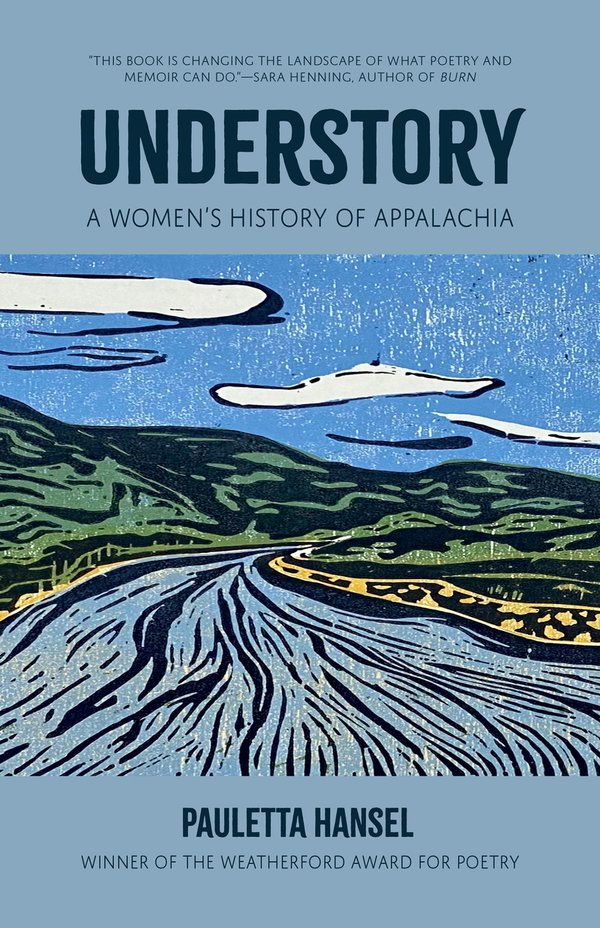 It was Halloween the day I received Pauletta Hansel, poet laureate emeritus of Cincinnati’s newest book, Understory: A Women’s History of Appalachia (University of Kentucky Press; Oct. 2026), which seems fitting for a book about ancestors.
As I sat on my front porch in suburban Chicago, handing out candy to children dressed as dinosaurs, fairies, and ghosts, I read snippets of Understory. I saw the tiny feet traipsing across the ground, faces smiling, pumpkin buckets swinging, and as macabre as it sounds, I thought of them 150 years from now, how Indigenous communities are often thinking seven generations into the future. Only Pauletta is looking at fourteen generations in the past and 400 years of women ancestors.
Like Pauletta, I have Appalachian ancestry. She grew up in southeastern Kentucky. I grew up in southwestern Missouri, raised by and influenced by Kentuckians. Neither of us live in Appalachia now, but we are always, in some ways, going home.
While driving about, the folks on the radio talked of the ‘thin veil’ between the spirit world, which happens right after Halloween, according to some. The day is gloomy and misty. Leaves are falling, sticking to pavement. They said something about spirits being ‘available’ always, that no one has ‘go anywhere’ to converse with them. That’s what I think Pauletta is doing in Understory. She went to storyland to converse with her ancestors. Whether that is under or over or between, she went there, and she took me along, in the pages, and in my heart.
In revealing generations of women whose experiences have only been glimpsed within others’ narratives, Understory is not simply one family’s story — bit a microcosm of the history of all Appalachian, and dare I say — all women?
Please join me in conversation with Pauletta Hansel, as we delve into this complex, hybrid picture of America’s past and present, a glimmering pot of genealogy, memoir, and poetry.

Leslie Lindsay: Pauletta, it’s a joy and delight to connect. Thank you for taking the time. I love the title, Understory, and while I know what your intention with the title was (because I read it in the book), I want to hear it from you, how you settled on this particular lens.
Pauletta Hansel: Thanks so much, Leslie, and I appreciate your reflections on the thinness of the veil on All Hallow’s Eve, as well as your curiosity about how these hobgoblins and witches eating up our candy will carry us forward through the centuries! It was the original North American matriarch of my family, Margaret Dawson Wroughton Attawell Grimes, born more than four centuries ago, who brought me into this particular story (or understory!), first for some poems for a previous book, Heartbreak Tree, and eventually for what became Understory.
The book’s title came a year or two into my research and writing. In ecology, the understory is the growth along the forest floor that is shadowed by the larger vegetation and ignored by the casual visitor, but absolutely essential to the health of the ecosystem. By the time I started thinking about titles, I had already determined that my manuscript was about the women of my family, and of our country and region, and this definition seemed spot-on. “Understory” at the time was the name of a single poem. And, of course, from an historical standpoint, there are always stories beneath the larger narrative which seldom get told. I’ll also say that my decision to focus on women was not as much a decision as an obsession. I have been writing about Appalachian women for as long as I have been writing, more than 50 years now, beginning as a teenaged poet in a small Kentucky town.
L.L.: This book is really a backward crawl through your family’s ancestry, going to the roots of the family tree, which began in England in the 1600s. One of the jumping off points was a story that your tenth great-grandmother was a “tobacco bride,” meaning she was shipped from England to Jamestown for 150 pounds of tobacco leaves! Let’s talk about that. Had you known anything about this before you started this project?
P.H.: I love answering this question because it lets me honor the late Danny L. Miller, who was an Appalachian scholar and avid genealogist, a friend to me and to so many others. He is one of the persons to whom I dedicate Understory, the others being my cousin, Loretta, and all our grandmothers. At a reading at Northern Kentucky University, where he taught, I overheard Danny telling someone that he could find a family connection with anyone from the Appalachian South. He wasn’t even talking to me! I inserted myself in the conversation to say that I didn’t think he could find mine, mostly because I knew so little about them myself. He kindly asked me for names, and among the oldest I could offer was my granny’s mother on my mom’s side, Sarah Margaret Rhoton of Clinchport, Virginia.
I was amazed to find out that he already knew from his research that she was a direct descendant of Margaret Wroughton who arrived in Jamestown in 1621 to be married off to a landed settler, though she had ended up with a tenant blacksmith, Ezekiah Wroughton, instead, and that their descendants had migrated to Appalachia after the Revolutionary War. I think Danny, too, was surprised that my question brought him another few generations of Margaret and Ezekiah’s line. That conversation with him was around 2006, and I thought it was pretty cool, but I didn’t do much with the information until 2021 when I needed a few more poems to finish my exploration of Appalachian women’s lives in Heartbreak Tree.
Danny had been dead many years by then, but the availability of information on the internet had expanded, so I was able to find out quite a bit about Margaret through an initial, quite casual, iPhone search — enough to write a few poems which is all, so I believed, I wanted. But I kept looking even after Heartbreak Tree was off to the publisher, and found out more about her, which then led me to the next grandmother, and the next. Now I am the one who plays the party trick of finding the ways I am related to my friends! But I don’t do it nearly as well as Danny did. He is irreplaceable.
L.L.: I want to talk about the project — because it certainly was that — a project. The process of writing Understory has much to do with travel, research, documenting, photographing, synthesizing, and more. It’s also a unique form, told in sections of travelogue and prose coupled with poetry. Often content informs form, and I’m curious how this came together for you?
P.H.: In Understory I write about one of my trips that, “as usual, what am I calling research is embarrassingly haphazard, with only a few moldy breadcrumbs to guide me.” Believe me, that statement is not false modesty. The book and its form came together through intuition, obsession, persistence (aka, hard-headedness), curiosity, listening to early readers’ suggestions, and a whole lot of luck. Though I recognize you have to do the work to put yourself in the position to get the luck. I began by writing poems, mostly about Margaret, and about the big picture of the eventual family’s movement into Appalachia. But I knew that for the poems I wanted to write, I needed to travel to the places the family had lived. I needed to smell the rivers and put my hands in the soil.
After one of those trips, I went directly to my annual gathering of Appalachian writers, and a wise friend who saw my photos and heard my descriptions suggested I write about my journeys. Around that time, I was asked to do a keynote address at a writers’ conference and I pulled together a PowerPoint with photos and poems, and wrote up my travel descriptions and some historical background to present something I called “Branch and Root: In Search of an Appalachian Family History.” One of the conference conveners said he hoped the final book would include that sort of weave, and I told him that I wasn’t sure I could get a publisher for such an unwieldy mix. But all that got me thinking, and a cleaned-up version of the presentation was accepted for publication by Appalachian Journal, so by the time I started sending out book proposals, it was as a hybrid.
I will also say that my research interests led me in that direction as well. I never intended the book to be about my family’s history alone, but rather to use us as a lens to write about the history of Appalachia. What I was uncovering was just so interesting to me that I wanted the contextual information to be in the book in a more direct — dare I say prosaic — way. I do write historical and documentary poetry, but it felt like I was trying to do too much for poetry alone to carry the weight of 400 years of history. And thus, the form came into being. I count myself really lucky that my editor at University Press of Kentucky was willing to take a chance on this hybrid form.
L.L.: There’s a section early in the book in which you say you will never be someone’s ancestor, that you are searching to the past for clues of your continuation, not ancestral lines, but maybe lines of poetry (paraphrased). I love that, but something about that also feels melancholy. I’d like to think your work — your writing — will survive you. It might be the most lasting legacy we can leave.
P.H.: Maybe. I do think discovering that my own mother, born in 1932, was the first woman in this line who was fully literate became a major impetus for the work. There was no possibility that our foremothers could have shared their stories in a lasting way. I say this in the book, but I know more about Margaret Dawson Wroughton Attawell Grimes, born circa 1596, than I know about my great-grandmother, Sarah Margaret Rhoton Mullins, born nearly 300 years later. Historians are interested in early Jamestown settlers.
Historians are not interested in poor Appalachian women. Add to this the ways that industrialization of the mountains effectively separated families, especially women who left ancestral homes to follow their husbands, thus limiting the transference of family lore. When we moved Mom from her home to a dementia unit, we found a 500-page handwritten memoir she had written some years before her illness. If she wanted to tell her story that badly, who is to say that the women before her had not also had that desire, but no way to fulfill it. Surely, with all my education and the fact that I am a writer by trade, I can do it for them. Surely, that is both my obligation and my honor. And maybe, just maybe, the fact that I have no children, while most before my mother had a dozen or so each, contributes to my freedom to take on a project such as this.
L.L.: In my own work, which also relies heavily on ancestry, tracing my Kentucky roots, I found it boring and burdensome to uncover ‘only’ dates and names. Like you, I wanted story. Pure story. You write about this in Understory in a poem aptly titled, I Want Stories. Can you speak more about that, please? Do you think you got the stories you so craved?
P.H.: Of course, I wish that I had stories that came to me from my foremothers in more direct ways. Letters, family memories, mentions in history books. But except for stories from my mother about her and my granny, and an occasional remembrance from a cousin or aunt, I simply did not. I include pretty much all of the oral histories I do have in Understory. But for the most part, I had to use a combination of research, imagination, and empathy to make stories of my foremother’s lives.
After I had written Understory, I found an interview with Frank X Walker, a remarkable historical poet whose work has influenced my own, who called his process “Memory, Research, Imagination and Empathy”, and I thought that is exactly right! I did not have much in the way of memory to draw from, and the research only got me so far. For example, one of the first poems in the book, “My 10th Great-Grandmother Remembers That Which She Sought to Forget,” is one of the last ones I wrote. In it, I imagine Margaret as a middle-aged woman who, as she experienced the hard work of survival in what by then is the Virginia Colony, “the mattock, hoe, /the wheel and spindle, / the fire and pot and kindling, / churn and bucket, / grindstone for the grain,” looked back on the hardship of her journey across the waters, not missing the ship, but missing the other young women and their shared hope for a better life. Which Margaret got, certainly, but it must have also been a lonely life.
I note that this poem came later in my writing, because in the early years I had not yet accumulated the research to be able write about what the Atlantic passage would have been like for Margaret, nor what her life along the riverbanks of the Virginia Colony would have entailed. But more than this, it was only after winding my way through the lives of all the grandmothers that I developed a longing to believe that they had each other — other women, be they kith or kin, to provide comfort and support. Many did, but others, Margaret and Sarah Margaret in particular, likely did not, and that poem reflects my ache for them in the absence of the kindness of other women.
L.L.: There are definitely some darker truths that surface in your family history, like all families and all histories. What took your most by surprise, shock, or dismay?
P.H.: It was most definitely my family’s history of enslavement of those of African descent, beginning with Margaret, that plucky little Jamestown Bride, who willed an enslaved servant to her grandson alongside heifers and cows. And then later, in Appalachian Virginia, one set of great-grandparents who were also early Methodists enslaved teenagers within their household. I had worked with the assumption that because my family and their communities were poor mountain people we were largely free of a slaveholding history, and that is simply untrue.
Also, though I had already known of incidents of domestic and sexual violence in the family history before I began Understory, tracing forward from this history into the lives of my own generation, including my own life, gave me a deeper understanding of the ways in which family trauma lingers beyond the lives of those directly affected.
And finally, I gained a greater awareness of how the centuries-old fight for control of the land played out in my family, and in the Appalachian region as a whole, beginning with how my family benefited directly from the removal of indigenous people and ending, at least in the book, with the economic and even physical harm caused by outside entities’ profit from the extraction of timber, coal, gas, and oil. Members of my family participated in this extraction, certainly, but I look at that as more survival than sin.
L.L.: Did you have any rituals or deep moments of contemplation; I’m wondering if you ‘spoke’ with your ancestors as you wrote? Other than the poplar tulip example in the cemetery, of course. Did you have moments of hearing an ancestor ‘speak’ to you, in a dream or meditative state, or otherwise?
P.H.: Late in the writing I enrolled in a class called “Writing with the Dead” which included both ritual and literary strategies to write about your ancestors. I had promised myself that I would write at least one poem for each of my great-grandmothers and was feeling stuck regarding those for whom I had virtually no information. The ritual aspect of the class opened up some new avenues for me. I took myself off to my favorite retreat center, and each morning I sat down and asked the ancestors’ permission to write about, for, and with them. It was a powerful week, and I came away with a dozen new poems that I felt good about. Sometimes it can be about setting intentions: “Ask, and it shall be given you; seek, and ye shall find; knock, and it shall be opened unto you,” as the Bible says.
I always tried to stay open to synchronicities and found that I was often in the right place at the right time, though I may not have known it till I got home and started writing up my notes. For example, on a largely unproductive trip to Delaware I joked to my husband we had to be close to where my people came from, given we were riding down a road called “Hardscrabble,” only to go home and discover that if we had gone a little farther we would have arrived at a crossroads, one named after known neighbors of my family and the other after a creek that had bounded their property.
And I am not sure that I ever dreamed an ancestor, other than my late mother who is with me often, but I did have one of my ancestors dream my dream. This was Mary, for whom genealogists found no surname, and only guessed at her given name. I first “heard” Mary’s voice as I was walking along a road in the Blue Ridge Mountains, which she would have crossed on her long journey from Delaware to the Carolinas. I ended up writing three poems in this voice, and in one of them she recounts a dream about her late mother that I had dreamt of my own.
L.L.: They say a work of art should change not just the artist, but the viewer or the reader. What two or three things really felt changed in you as you wrote Understory?
P.H.: Undertaking such a large project gave me more confidence as a writer, a sense that I have the perseverance and stamina to work — or at least stumble — my way through to a conclusion I feel good about, no matter the barriers I face. Going back to one of your earlier questions, I also don’t worry so much now about what I leave behind to future generations but instead feel a deep gratitude for the women who have carried me to the place I am now. More gratitude for my life circumstances in general — a good education that I can put to good use, a comfortable home, a happy marriage — and to my own parents who worked so hard to heal family trauma without erasing family connections. My sister, the oldest, they named Renée, to signify the rebirth that they saw their union achieving. Me, they named Pauletta, after my father’s mother Pauline and my mother’s mother, Etta, daughter of Sarah Margaret and thus granddaughter of Evaline, Bettie, Eveline, Polly, Rhoda, Anna, Betsey, Mary, Elizabeth, Rachel, Hannah, Joanna, and Margaret. As am I.
L.L.: Pauletta, thank you so very much, this has been so delightful. Is there anything I forgot to ask, but should have?
P.H.: Thank you so very much! I loved responding to your insightful questions and look forward to reading about your family — soon, I hope!
Leslie Lindsay
Staff InterviewerLeslie A. Lindsay is the author of Speaking of Apraxia: A Parents’ Guide to Childhood Apraxia of Speech (Woodbine House, 2021 and PRH Audio, 2022). She has contributed to the anthology, BECOMING REAL: Women Reclaim the Power of the Imagined Through Speculative Nonfiction (Pact Press/Regal House, October 2024).
Leslie’s essays, reviews, poetry, photography, and interviews have appeared in The Millions, DIAGRAM, The Rumpus, LitHub, and On the Seawall, among others. She holds a BSN from the University of Missouri-Columbia, is a former Mayo Clinic child/adolescent psychiatric R.N., an alumna of Kenyon Writer’s Workshop. Her work has been supported by Ragdale and Vermont Studio Center and nominated for Best American Short Fiction.