

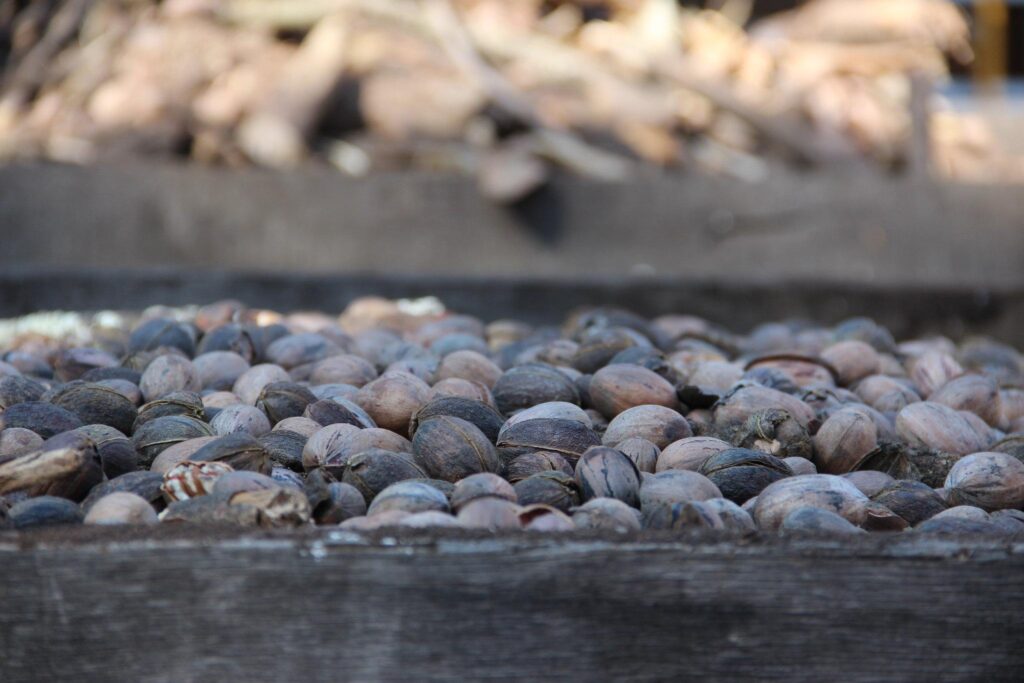
The house was flanked by pecan trees. Mama picked up so many over the years she could’ve built a second house out of them. One with a nutcracker for a key.
Most of the trees dropped thick-shelled pecans, stubborn things that required a nutcracker. But one tree gave paper shells—long, thin, and easily split with a firm squeeze. Mama loved those. So did the squirrels.
Every fall, strangers wandered into the yard to gather them by the bagful. Mama shooed them off. Those pecans were hers.
She was known for pecan pie. She brought them to every family gathering, always made with pecans from the yard. I never ate them as a child, but I sat with her and helped shell them.
When I was very young, Mama took on a small job assembling plastic fishing worms for a local bait company. The bodies came in one box, the ribbon tails in another. She’d melt the end of a tail with a taper candle and press it to the body until it sealed. Purple, green, gold, glittering. I remember the smell of warm plastic and the way her hands moved like they’d always known how. The same hands that cracked pecans. That stirred the filling for her pies.
When hospice came, Mama didn’t want an aide. “Just another person up in my house,” she said. But she agreed to meet her once.
Lynn arrived in the fall, when the pecans were dropping.
She had honey-colored hair and a presence that made you feel like you didn’t have to perform. She didn’t call herself a death midwife, but that’s what she was. Someone who ushered people out of the world the way others usher babies in.
She helped with baths, clipped nails, rubbed lotion into tired arms. But what mattered most was her presence. They took slow walks through the yard, gathering pecans as they went. Lynn always asked before pocketing any, saving them for her pet squirrel, Lucky—raised from a baby. No one was supposed to know about Lucky, but Mama did.
“Lynn feels like springtime,” Mama told me once.
As fall turned, Mama fixed her sights on Christmas. She wanted the tree up early. My sister and I wouldn’t be home until December, but Mama needed it done before then. So Lynn put it up. Someone said she shouldn’t let a stranger do that.
But Lynn was no stranger. She was spring.
One afternoon, I stood in the kitchen drinking coffee while Mama rested in the other room. “She’s declined a lot since last week,” I said.
Lynn took a sip. “It’s starting.”
“How long do you think we have?”
“It’s hard to say,” she said. “But I know I’ll see her again.”
She told me she could usually feel when it was the last visit the moment she stepped through the door.
A few days before Christmas, Mama surged. She pulled out quilts, pointed to heirlooms, gave instructions. I knew most of them, but I wrote everything down anyway.
“Don’t put a bra on me. No wild rock music at my funeral. I like white flowers but no frou-frou shit. I’ll try to wait for spring to die. No guarantee.”
A week later, she was hovering—not here, not gone. We sat up through the night, surprised to find her still with us at dawn. It felt like she was waiting.
“She’s waiting for Lynn,” my sister said.
Because of the holidays, Lynn hadn’t been by in several days. She had said she’d see Mama again. Mama had said she’d wait for spring.
We kept Mama’s phone nearby, though she could no longer speak. When it rang that morning, we all looked up. Lynn was on her way.
When she arrived, I met her on the porch, already crying.
“It’s time,” I said.
“I know.” She rubbed my face like a mother.
Inside, she crossed the threshold, took vitals, made notes, called the nurse. Then she sat by the bed and rubbed lotion into Mama’s feet one last time. She stayed a while, content to simply be. When she stood to leave, I walked her out and reminded her to take pecans for Lucky.
Mama passed shortly after. She had waited on spring.
In those last days leading up to death, I gathered pecans from the yard like Mama had done for years, filling my robe pockets. Especially the paper shells. I said little prayers over each one.
I make the pecan pie now.
 Amanda Ashworth is an English teacher and writer from rural Tennessee. She keeps one foot in the classroom and the other in the creek. Her work has appeared in Salvation South, Reckon Review, January House, and Halfway Down the Stairs. Rooted in Appalachian folklore, family stories, and the quiet rituals of Southern life, her writing explores memory, inheritance, and the landscapes that continue to shape us.
Image Credit: Flickr Creative Commons/Emily Landers
What a wonderful heartfelt story! Very talented writer!
Captivating!
What a stunning and heartfelt tribute to both her mother, Lynn, and a tradition passed down from mother to daughter.