

My mother doesn’t quite process the news and looks to me for help. The doctor says, I know Alzheimer’s sounds scary, but it’s just a name. Dr. Alois Alzheimer, a German neurologist, first identified the disease. But there are options now, new developments.
When the doctor shows us the results of the PET scan and MRI confirming the diagnosis, my first thought is that Alois made his last name a scary disease. Whether he likes it or not, it invokes fear. Maybe he should have thought of that first. Maybe we can name diseases like hurricanes. Go through the alphabet, generate them randomly as the eye of the storm barrels down the coastlines of our bodies before touching down.
My mother’s doctor looks at me and my face gives nothing away. I am knitting together the telltale signs in my head, and there is a long scarf being made of my memories and hers, two-toned and thick like a spiral of DNA.
When did you first suspect? he asks.
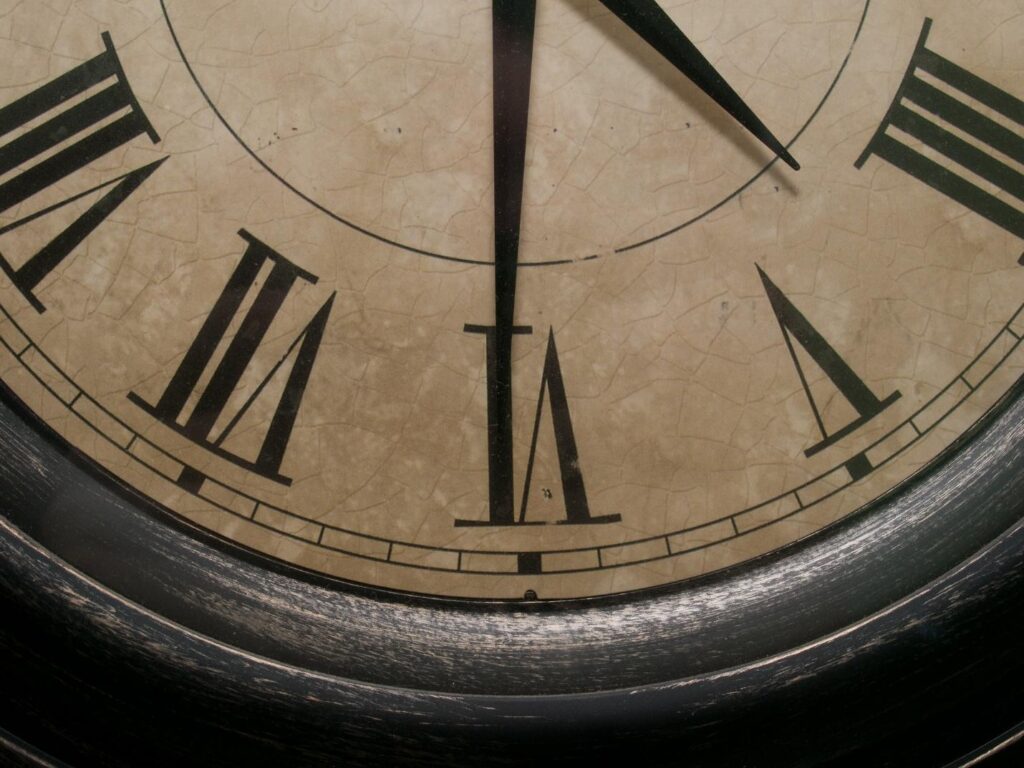
I wonder if he can see my brain rewinding, the way I’d sometimes move the hands backward to change the time on the antique wall clock my mother gave me and my husband as a housewarming gift, a Westminster chime that sang the quarter hours throughout our first home.
It’s the heartbeat of the house, she said, and she informed us that to change the time, you slowly moved the hands forward, clockwise, never back.
Moments ago, my mother was instructed by a nurse to draw a clock. She drew a circle. Then she was instructed to draw the hands at ten minutes before two, like hands on a steering wheel. But ten and two stumped her, and she froze for five long minutes, which became a meditation. Became a sign. Became a diagnosis. The hands went nowhere. They didn’t even start in the middle. She drew one shaky line that snaked its way off the page entirely, like a car veering off a road, as my mother looked to me for help, tears in her eyes, and my mother is not a crier. She is a fighter. She is an athlete. She is not that person. I saved the moment as a bookmark. Something to address later. Time moves differently now. It soars off the page. I reached for her hand. Gave it a squeeze. Turned my insides to steel.
Next came the words.
Name all the words you can that start with B, the nurse said. Then she looked at me to make sure I didn’t give her the answers. She must’ve known, because I pursed my lips instinctively. The way I did with my children, teaching them the alphabet. Bah, bah, bah.
My mother got a few B words out, then landed on bitch. The nurse smiled, wondering if she was referring to her as she asked questions. But my mother was looking at her hands in her lap. They were my hands in thirty years. Thin, boney, with glacial blue veins running like rivers, deepening over time. We have the same hands.
When we went elsewhere for a second opinion, the neurologist asked her to list words that begin with F and I answered in my head. Fuck. Fuck. Fuck. I said what she was thinking. I wanted to answer for her like I always do. To fill in the words, fill in her memories. I wanted to continue feeding her food and words, write out her bills, do her taxes, answer her text messages and emails so everyone who gets them doesn’t see what is happening. I have fooled them all. I had fooled myself until ten and two. Because, honestly, I’m not shocked. Putting a name on my mother’s forgetfulness is the shock. Or maybe shock isn’t the right word. Maybe it’s just confirming a fear I was too scared to know because my mother and I are both a little resentful of the knowing. Give me batty. Give me spacey. Give me brain fog or an old age joke, not this definitive assessment. I’m just a little forgetful, she will say. Who isn’t?
Faith.
She paused and I thought she would stay there, a one-word response, but faith took over and she started again. Faith. Frank. Food. Fun. She sputtered. The doctor nodded. She tried fighting the diagnosis. Friendly. Folks. Feed. Fake. Fool. She tried beating it like she was back on the tennis court being served balls that she returned with her killer backhand. She played tennis all her life, reduced now to pickleball that she obsesses over.
At the next appointment. she wasn’t given a clock to draw. This appointment was to see if she was a good candidate for infusions that slow the deterioration, slow the clock, she was told. She did better on the test, the F words came easily, the animals she knows, the words she was supposed to remember were two out of four, not bad, but she was not a good candidate. The risk of brain bleeding was too great and she could have another stroke. Through this process, I am learning the language of doctors. I am learning strokes can happen silently, without event, that one happened to her and we cannot for the life of us remember a time it may have happened. A dark shadow that takes a coil of memory and slips out the backdoor. A skilled thief. I am learning how much of a miracle we are, walking around with functioning organs that need no instructions, blood that never stops moving. I am learning all the folds of the brain and where we store our secrets. Each scan exposing a solar system in a galaxy. A galaxy in a universe. And us, the starlight traveling long after we’re gone.
My mother and I are back at ten and two, in the office where we are hearing the diagnosis spoken aloud for the first time, and I am rewinding my memories while the doctor waits for my response. I have stopped the clock.
I am also not a crier. When my mother looks at me with tears, I swat them away and head straight into survival mode. I will not allow myself to feel the grief until there is a seemingly unrelated moment. My body is dodgy that way, an overstuffed bag that springs small leaks. I’ve always written my way to understanding, sorting through words until I find the right combination of grief. That is why I am frightened of forgetting. If I forget, how will I put words on a page? Will I be left with them trapped in the folds of my brain, left in a scramble? Left in a scream?
My mother and I are haunted by the same memory — a visit to her mother in a nursing home long ago. We walked the long, gray hallway housing decay to a room where her mother was being fed pudding in a wheelchair. The nurse spoke for her. My grandmother hadn’t said a word for three years and when we looked into her eyes, there were no words there either. Nothing left of who she once was. My mother will not offer up this family history when a doctor asks. Alzheimer’s was just assumed, but never diagnosed. An incurable disease is only worthy of a whisper.
My mother’s memory is sharpest with events and people long gone. She pulls them from her pockets like gemstones, rolls them in her palm to marvel at. Remember when, she says, as if to prove she will not have the same fate as her mother. Remember when. Remember when. It is stunning the names she pulls together. They are tiny births we marvel at together. The old neighborhood. The childhood friends. The songs we sang when we drove the Carefree Highway. Always Patsy Cline. I go out walking. After midnight. In the moonlight.
Where did you pull that one from, Ma? Then I worry she is walking after midnight in her nightgown like her mother had, wandering the streets. Her short-term memory too frayed. Her brain too full of who she used to be.
I don’t know, she laughs. How did I remember that?
There’s no one with a greater sense of humor than her. She laughs quick and easy. She laughs at what life throws her way, returns each lob with an effortlessness that draws people to her. I have been told by so many how much they love my mother. She is easy to love. Her personality is intact. Light. Quick to compliment. Quick to link herself to a person with a connection she is determined to find, even as it gets harder, even as the pauses grow longer. Bear with me, bear with me, she will say. And if I am near her, I will not let time have its pause. I will jump in to keep everything moving, no matter the circumstance. I have become the train conductor, worrying about each station, trying not to stall on the tracks. I will find a connection even if I have to make one up.
I gave my mother an Apple Watch for fall detection a year ago, worried about her being alone. The numbers are digital. There are no hands bearing the weight of time. The numbers float, time moves without notice, and it sometimes feels like cheating, not having hands to decipher. I have my mother’s thin wrists. I tried the band on to make sure it would fit. As with jewelry, if it fits me, it will fit my mother. Every piece I’ve ever bought her, I try on first. We have the same hands. We have the same hands.
Two years ago, I pulled over after dropping her back to her home. She’d gotten a UTI, was delirious, and I took her to the ER. I nursed her back to health at my house for a week. Then got her set up at her condo. I left her with soup and a TV remote, then I drove away before I felt I would come undone. I pulled over a mile away and wept. I knew she was slipping. I had slowly stopped telling her things that would give her worry. I slowly wrote out the checks. I slowly told her the names of her grandkids. I made sure I had her location to navigate her home. I took over so slowly I wouldn’t notice. She wouldn’t notice. No one would notice.
I once broke the antique wall clock my mother gave me. It took a long time to find a person who could fix it. I found a clockmaker who looked like Geppetto, surrounded in wood and the delicate parts of gears and weights, glasses on the tip of his nose, face framed in a shock of white hair. He marveled at the clock she’d given us. It’s a good one, he said. Handcrafted. Not many of these left. Not many guys like me left who can fix them either. I had overwound it too many times in haste, had taken shortcuts and rotated the minute hand counter-clockwise, thinking surely a small movement here and there wouldn’t hurt. Until it stopped completely.
The doctor is still waiting for me to answer. How long did I suspect? My mind settles.
I have known for maybe two years, I say. He nods and moves on quickly to treatments, a prescription of Donepezil, more scans, more visits, not wanting to linger too long on the moment, and I get it. We can only move the hands forward. Clockwise. Otherwise something will break. That’s just the way time works. I listen to the chimes reverberating throughout my house and think of them as starlight, reaching us long after we’re gone.
Time moves differently now for us both.
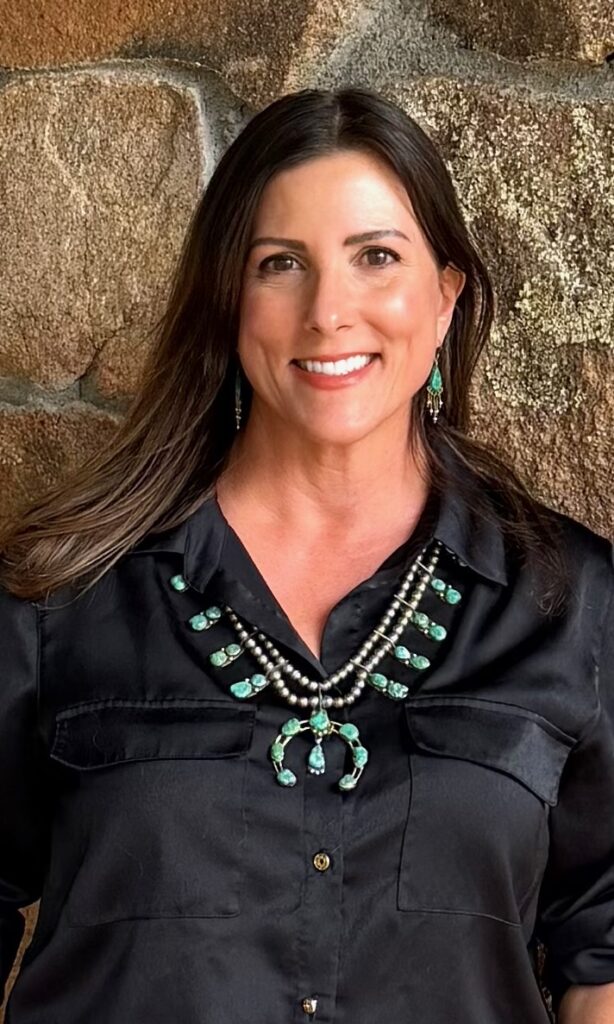 Sabrina Hicks lives in Arizona with her family. She is the author of Coyote Girl: Stories (CJ Press; spring 2026). Her work has been anthologized in Best Small Fictions, Best Micro Fictions, and Wigleaf Top 50. A full list of her publications can be found at sabrinahicks.com.